
Published on September 23, 2025 · 7 mins read
The Future of Fashion Shopping: Virtual Try-On with AI and AR
From online shopping to metaverse fashion, Virtual Try-On (VTO) is reshaping how we interact with clothing. What once required a fitting room now happens instantly on your screen — and you can build it into your own app today.
– By Keerthana, AI/ML Developer, Yuvabe Studios
Answer Summary:
Virtual Try-On (VTO) uses AI and AR to let shoppers preview clothing digitally before purchase. This blog explains why VTO matters for fashion e-commerce, the AI technologies behind it, and how to build a simple virtual try-on app using Next.js and Pixelcut API.

Why Virtual Try-On Matters
E-commerce fashion faces a challenge: returns. Shoppers often hesitate because they can't imagine how a garment will look or fit, which leads to wasted resources and lost revenue. Virtual Try-On solves this problem — and offers much more:
- Confidence in Online Shopping: Customers can preview styles before purchase, leading to higher conversions.
- Higher Engagement and Conversion:Like Instagram filters, VTO lets shoppers play with multiple looks in minutes.
- Sustainability Through Fewer Returns: Fewer returns mean lower carbon footprints and reduced textile waste.
- Innovation in Fashion and Metaverse Commerce:From AR filters to metaverse wearables, VTO is shaping the future of fashion.
For fashion brands, this isn't just about convenience. It's about redefining the shopping experience and creating deeper trust with consumers.
Research Driving Modern Virtual Try-On
Recent breakthroughs in AI and computer vision have taken virtual try-on from clunky to hyper-realistic:
- Outfit Anyone: Flexible try-on across body types and garment styles. Paper Link
- TryOnDiffusion: Diffusion models with parallel UNets for detail + warping. Paper Link
- StableVITON: Solves semantic alignment between body and garment. GitHub Repository
- DCI-VTON: Conditional inpainting for ultra-high-resolution outputs.
These research models combine GANs, diffusion models, and semantic segmentation to make fashion try-on scalable and lifelike.
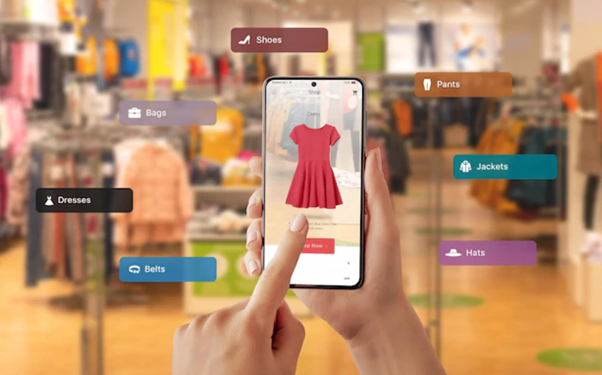
The Technology Behind Virtual Try-On
Recent breakthroughs in AI and computer vision have taken virtual try-on from clunky to hyper-realistic:
- Augmented Reality for Real-Time Overlay: Overlays digital clothing on your real-time image.
- 3D Body Scanning and Fit Estimation: Creates accurate models of your body for perfect fit visualization.
- Artificial Intelligence for Realism: Improves recommendations and realism by learning your preferences.
- Computer Vision for Movement Tracking: Tracks movement so clothes adjust naturally when you move on camera.
These research models combine GANs, diffusion models, and semantic segmentation to make fashion try-on scalable and lifelike.
How Virtual Try-On Works
At its core, a virtual try-on system follows four steps:
- Image Capture or Upload: Customer uploads a photo or uses the camera.
- Body Detection Using AI: AI identifies the person in the image.
- Garment Alignment and Overlay: Clothing is aligned and placed realistically.
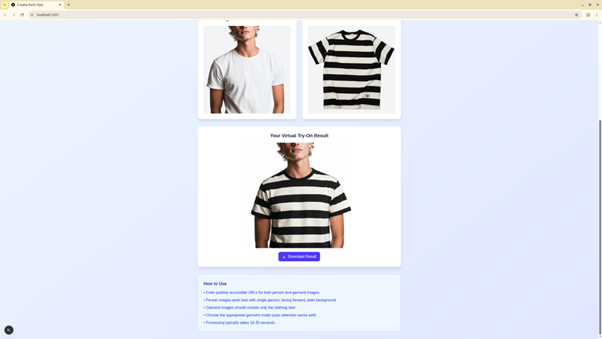
- Final Try-On Result Display: Final try-on image is shown or downloaded.
Think of it like asking a digital mirror: “How do I look in this?”
Our Experiment at Yuvabe Studios
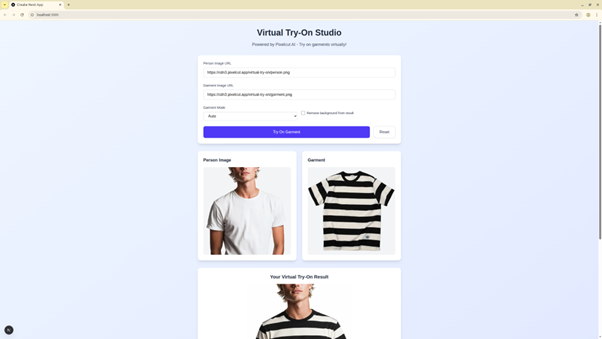
To demonstrate how accessible this tech has become, we built a simple VTO app using Next.js and the Pixelcut Free API. Instead of training models from scratch, the API handles garment alignment and fitting.
Our goal was simple :
- Let users upload a photo of themselves (or a model).
- Upload a clothing image.
- Instantly generate a try-on preview.
Technology Stack Used
- Next.js for Front-End Interactivity (React framework): Front-end for interactivity. Next.js
- Pixelcut Free API for Garment Fitting: AI-powered garment fitting. Pixelcut API
- Tailwind CSS for Responsive UI: Clean, responsive design. Tailwind CSS
- Node.js and Vercel for Secure API Calls: Secure backend calls to Pixelcut API.
This stack ensured fast development, scalability, and a smooth user experience. Our approach made it possible to go from concept to prototype in days, not months.
Building the Virtual Try-On App in Next.jsNext.js
1. Frontend Implementation
We built a form where users can input person and garment image URLs, select garment mode, and toggle background removal.
// page.tsx
'use client';
import { useState } from 'react';

export default function Home() {
  const [personImageUrl, setPersonImageUrl] = useState('');
  const [garmentImageUrl, setGarmentImageUrl] = useState('');
  const [result, setResult] = useState<string | null>(null);

  const handleSubmit = async (e: React.FormEvent) => {
    e.preventDefault();
    const response = await fetch('/api/try-on', {
      method: 'POST',
      headers: { 'Content-Type': 'application/json' },
      body: JSON.stringify({ personImageUrl, garmentImageUrl }),
    });
    const data = await response.json();
    setResult(data.result_url);
  };

  return (
    <main>
      <h1>Virtual Try-On Studio</h1>
      <form onSubmit={handleSubmit}>
        <input value={personImageUrl} onChange={(e) => setPersonImageUrl(e.target.value)} placeholder="Person Image URL" />
        <input value={garmentImageUrl} onChange={(e) => setGarmentImageUrl(e.target.value)} placeholder="Garment Image URL" />
        <button type="submit">Try On</button>
      </form>
      {result && <img src={result} alt="Try-On Result" />}
    </main>
  );
}
2. Server-Side API Route
Next.js API routes securely call Pixelcut Free API with your key:sentiment-analysis pipeline:
// pages/api/try-on.ts
import type { NextApiRequest, NextApiResponse } from 'next';

export default async function handler(req: NextApiRequest, res: NextApiResponse) {
  const { personImageUrl, garmentImageUrl } = req.body;

  const response = await fetch('https://api.developer.pixelcut.ai/v1/try-on', {
    method: 'POST',
    headers: {
      'Content-Type': 'application/json',
      'Accept': 'application/json',
      'X-API-KEY': process.env.PIXELCUT_API_KEY || '',
    },
    body: JSON.stringify({
      person_image_url: personImageUrl,
      garment_image_url: garmentImageUrl,
      garment_mode: 'auto',
      preprocess_garment: true,
      remove_background: false,
      wait_for_result: true,
    }),
  });

  const data = await response.json();
  res.status(200).json(data);
}
Final Thoughts: Why This Matters Beyond the Demo
This project shows that you don’t need to be a big tech giant to build fashion AI apps. With the right APIs and frameworks:
- Developers can spin up prototypes quickly.
- Startups can add virtual fitting rooms to e-commerce platforms.
- Designers can preview collections instantly on digital models.
- Marketers can create campaigns without costly photoshoots.
At Yuvabe Studios, we see VTO as more than a feature — it's a business advantage . By blending AI, AR, and creativity, fashion brands can increase conversions, reduce returns, and build sustainable customer trust.
Curious how a Virtual Try-On experience can be tailored to your fashion brand?Let's talk.
This project proves you don’t need to be a big tech company to experiment with fashion AI. Using Next.js and Pixelcut API:
- Developers can prototype VTO apps in days, not months.
- Startups can add virtual fitting rooms to their online stores.
- Designers can preview garments on models instantly.
- Marketers can create dynamic campaigns without expensive photoshoots.
At Yuvabe Studios, we see this as a sneak peek into fashion's future — blending AI, AR, and creativity to make fashion more immersive and sustainable.
Want to build AI-powered fashion apps tailored to your business?Let's talk.
Outcomes and Real-World Applications :
At Yuvabe Studios, our AI/ML team turns complex ideas into purposeful innovations. From on-device AI, virtual try-on apps, and predictive trend engines, to data pipelines, model optimization, and intelligent user experiences — we bridge research and real-world impact. We partner with beauty, healthcare, consumer, and fashion brands, helping them adopt AI solutions that are scalable, privacy-first, and built for real business growth.
Frequently Asked Questions (FAQ)
Here’s Few things you need to know about Virtual Try-On
Virtual Try-On uses AI and AR to let users digitally preview clothing on their body using images or live camera input.
AI models use computer vision, segmentation, and diffusion techniques to align garments realistically with different body types.
Yes. Using frameworks like Next.js and APIs such as Pixelcut, startups can prototype VTO apps quickly without training models from scratch.
Yes. By helping customers visualize fit and style before purchase, VTO significantly reduces return rates and waste.
Yuvabe Studios designs AI-powered fashion solutions including virtual try-on, generative visuals, and predictive trend tools tailored for real business use.